



The media landscape is witnessing a massive paradigm shift as the boundaries between traditional television, premium streaming, and social media continue to blur. According to the newly released Wave 11 of the “TV Advertising: Fact vs Fiction” report by Hub Entertainment Research (published June 2026), consumer attitudes toward advertising are evolving rapidly, driven by economic pragmatism and the introduction of artificial intelligence.
The extensive study reveals that while viewers are more willing than ever to trade their eyeballs for discounted or free content, a widening perception gap is forming between overly enthusiastic advertisers and increasingly skeptical consumers regarding the use of Generative AI.
The Ultimate Victory of the Ad-Supported Tier
For years, premium streaming pitchmen argued that consumers would pay any premium to maintain an entirely ad-free lifestyle. June 2026 data shows that fiction has officially been debunked by fact. Today, 7 in 10 consumers would rather watch ads than pay a higher monthly subscription fee.
The report tracks a significant five-year behavioral pivot in consumer preferences when choosing between saving money or avoiding ads:
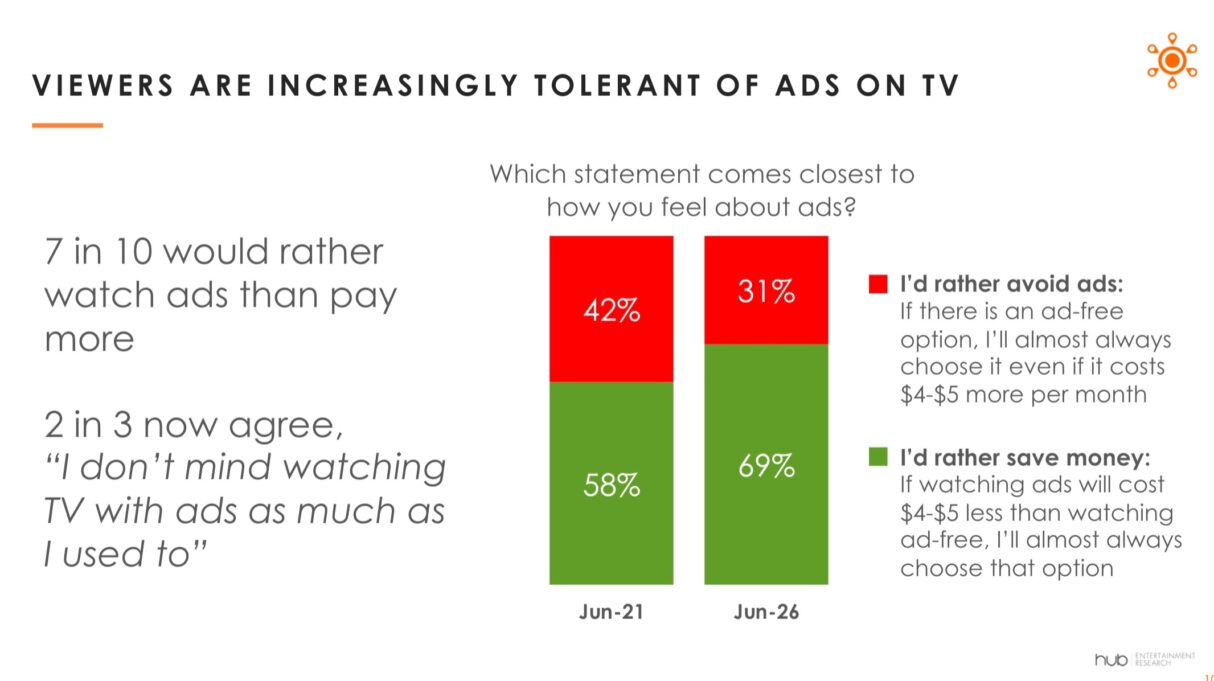
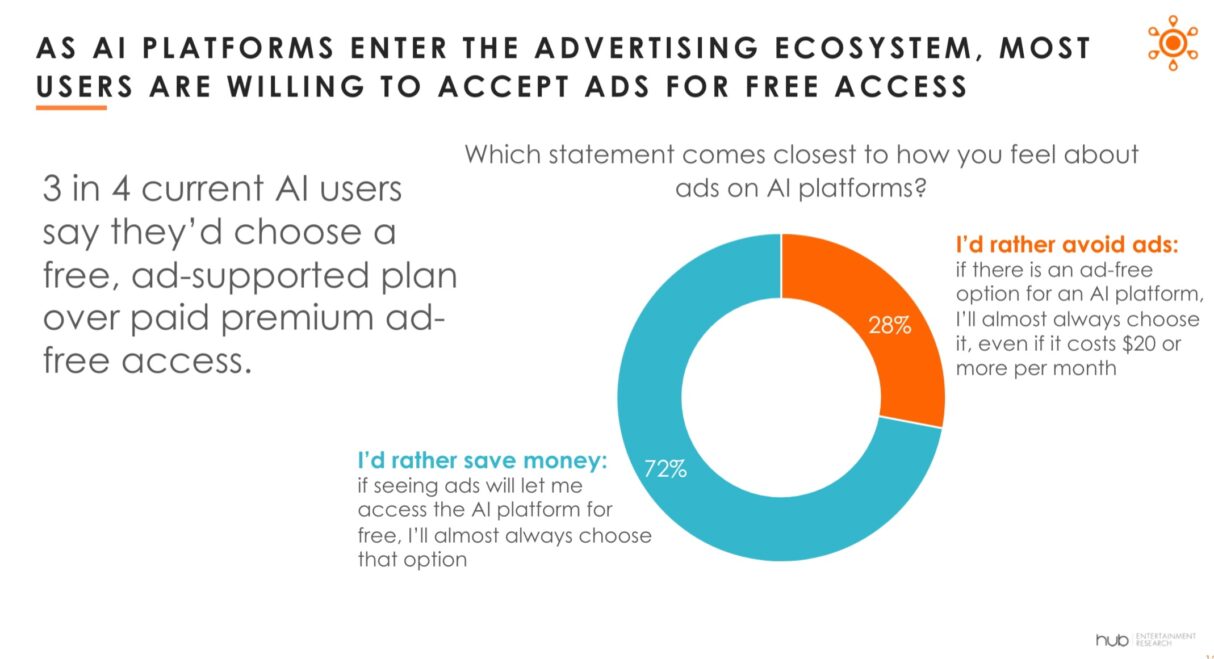
Furthermore, nearly two-thirds of respondents now agree with the sentiment: “I don’t mind watching TV with ads as much as I used to.” This tolerance is trickling into the emerging tech ecosystem as well. As AI platforms integrate advertising into their business models, 72% of current AI users state they would choose a free, ad-supported tier over paying $20 or more per month for an ad-free experience.
Gen Z and the “Passive Attention” Phenomenon
Advertisers worried about the multitasking habits of younger demographics may find solace in Hub’s latest metrics. Even when Gen Z viewers are scrolling on a secondary device or completing other tasks, they remain highly perceptive of what is playing on the television screen.
When asked how aware they were of the commercials playing while multitasking, younger cohorts significantly outpaced older generations in ambient attention:
- Gen Z (Ages 16–29): 26% reported being “very aware” and 43% were “somewhat aware” of the ads. Only 9% claimed to be “not at all aware.”
- Gen X & Boomers (Ages 46–74): Only 14% were “very aware,” while 33% were “somewhat aware.” A higher 15% were completely oblivious to the background ads.
The Trust Premium: TV vs. Social Media
Despite Gen Z’s heavy reliance on creators and social ecosystems—where publications note that half of U.S. consumers learn about brands via social networks—television platforms still hold a massive structural advantage: Trust.
Across generational divides, the majority of consumers trust TV services over social media networks to manage data responsibly and serve vetted, safe ad experiences. Specifically, 57% of Gen Z and 56% of Gen X/Boomers strongly or somewhat agree that they trust TV providers more than social media platforms with their personal information.
Data Privacy: What’s Fair Game for Relevance?
As AI-driven hyper-personalization becomes standard practice, marketers are walking a thin line between precision and privacy. Hub’s research highlights that consumer willingness to trade personal data for more relevant ads heavily depends on the type of data being collected.
The report measures consumer willingness (% completely or somewhat willing) to share information with TV services:
- Content Preferences: 65% are willing to share their viewing history.
- Basic Demographics: 59% are fine sharing their gender, and 57% will share their age.
- Digital Footprints: Only 36% are willing to open up their social media posts.
- Financials: 35% are comfortable sharing their annual income.
- Conversational Privacy: Only 33% are willing to expose their chat history with AI applications.
Unsurprisingly, familiarity breeds acceptance. Regular social media users—who encounter targeted algorithmic ads daily—view ad targeting far more favorably (40% positive, 13% negative) than those who never use social media (14% positive, 32% negative).
The AI Ad Gap Widens: Utility vs. Creativity
The ultimate battleground for the future of broadcasting lies in how Artificial Intelligence is deployed. Hub’s research incorporates specialized tracking from IAB and Sonata Insights, revealing a staggering sentiment divergence between the industry’s decision-makers and the general public.
While 82% of advertisers believe consumers view Gen-AI advertisements positively (up from 80% in 2024), actual positive consumer sentiment has actually dropped from 48% in 2024 to 45% in 2025–2026. Even more alarming for agencies, consumer negativity toward AI ads has nearly doubled, jumping from 16% to 30% over the same timeframe.
Where Consumers Actually Want AI
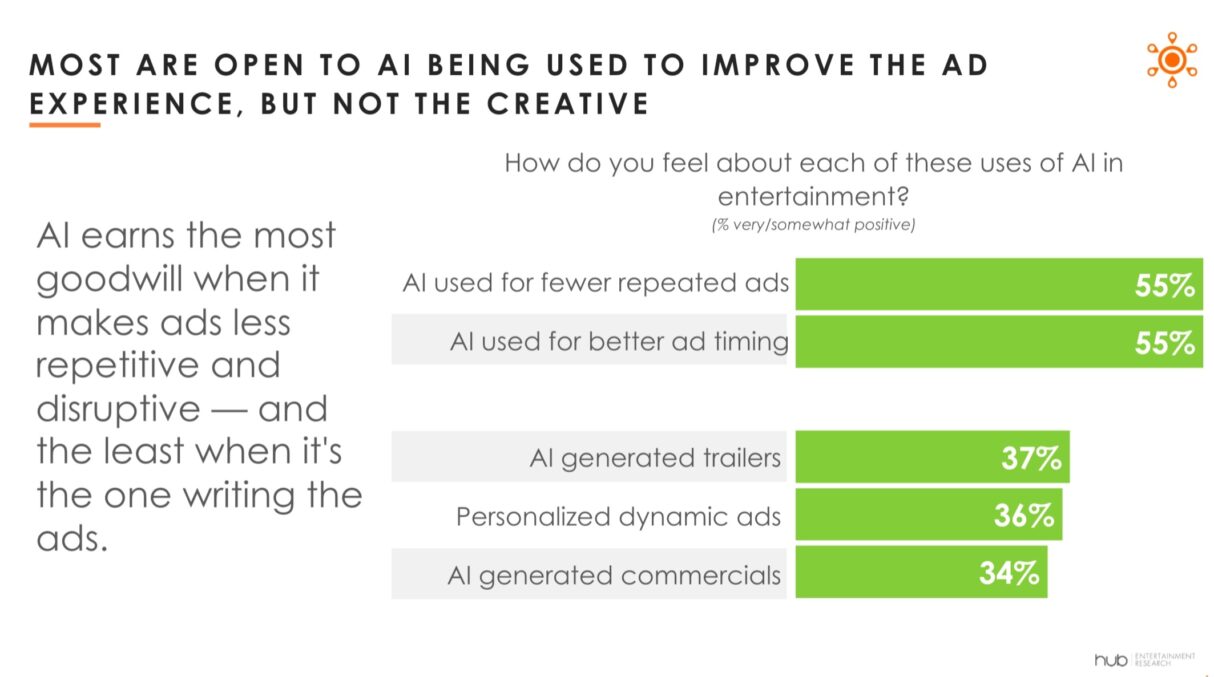
Consumers do not hate AI; they hate bad execution. The data shows that AI earns the most consumer goodwill when it is used as a backend tool to optimize the viewer’s user experience, rather than acting as the creative force behind the commercials.
About the Methodology
The findings are extracted from Wave 11 of Hub Entertainment Research’s ongoing tracking initiative, completed in April 2026. The study surveyed 3,000 U.S. TV consumers aged 16–74 who watch at least one hour of television per week. The sample is balanced to reflect U.S. Census data. Crucially, unlike alternative digital-only reports, consumers were not required to have broadband access to participate, ensuring a more comprehensive look at traditional, hybrid, and cord-cutting households alike.