



YouTube Premium has become one of the five most frequently subscribed-to paid video platforms across Central and Eastern Europe, reaching levels comparable to Disney+ in several markets, according to new research from WPP Media. The ViewTube CEE study also points to a changing streaming landscape, as SVOD platforms turn to advertising and partnerships with pay TV operators and telecom companies to sustain growth.
How Popular Is YouTube Premium in Central and Eastern Europe?
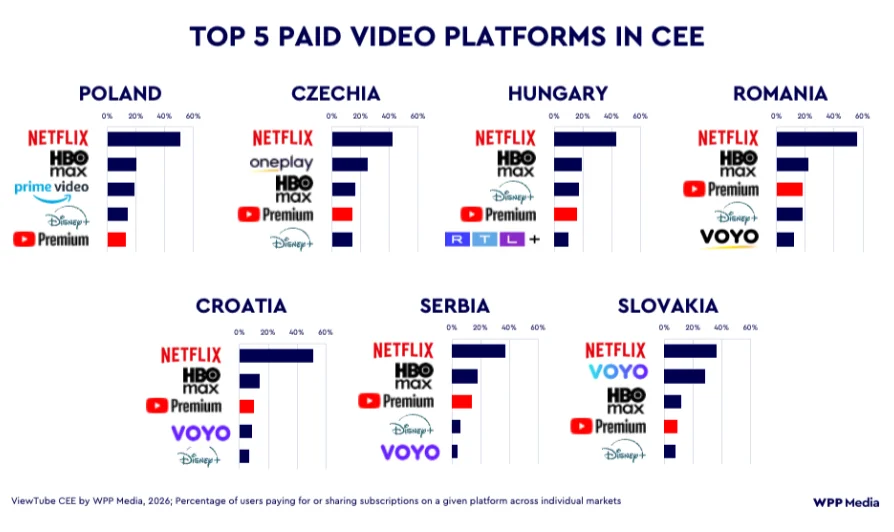
Covering Poland, Czechia, Hungary, Romania, Slovakia, Serbia and Croatia, WPP Media’s ViewTube CEE study finds that between 8% and 18% of internet users across these markets pay for or share a YouTube Premium subscription.
The service performs at a level comparable to Disney+ in Poland, Czechia, Slovakia, Romania and Hungary. In Croatia and Serbia, where the number of paid streaming customers is lower, YouTube Premium ranks among the top three paid video platforms, surpassing Disney+ in popularity.
Unlike Netflix, HBO Max and Disney+, which primarily compete through films, series and original productions, YouTube Premium attracts subscribers with a different content mix. Music and music videos are the leading content categories across all seven markets surveyed. Entertainment, how-to programmes, documentaries, podcasts and news also feature prominently, while younger viewers aged 16–24 show stronger interest in creator content, vlogs and gaming.
Who Is Most Likely to Subscribe to YouTube Premium?
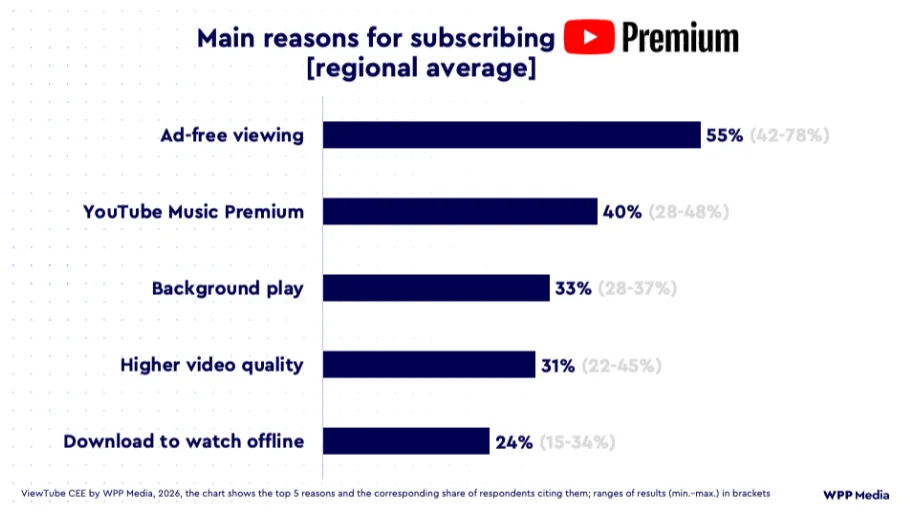
The main reason users pay for YouTube Premium is the ability to watch videos without advertising. Access to YouTube Music Premium, background playback and offline downloads also contribute to the service’s appeal.
WPP Media identifies users aged up to 34 as particularly prominent among subscribers. Parents of children aged 0–6 stand out even more: across every market included in the research, they subscribe to YouTube Premium at approximately twice the average rate.
For advertisers, this creates a challenge. As WPP Media Market Manager CSEE and CEO WPP Media CSEE Izabela Albrychiewicz explains, YouTube Premium competes for the same audience attention and spending as traditional streaming services, even though it offers a different viewing experience.
“Although they are buying something different on YouTube than on Netflix or HBO Max, they are willing to pay, and YouTube Premium’s place among the top five demonstrates the platform’s strong position.”
Why Are Streaming Platforms Partnering With Pay TV Operators?
The ViewTube CEE findings also highlight an increasingly close relationship between SVOD services, pay TV operators and telecom companies. WPP Media describes this dynamic as a “frenemy” relationship: the companies compete for viewers’ attention and spending while increasingly relying on partnerships to reach customers.
Between 14% of SVOD customers in Croatia and 38% in Serbia purchase streaming subscriptions through pay TV operators. Telecom partnerships are also significant, accounting for between 12% of SVOD access in Romania and 34% in Croatia.
These arrangements are becoming increasingly important for pay TV operators. Despite predictions of widespread cord-cutting, WPP Media reports no visible exodus from pay TV across the CEE markets surveyed. Many customers also receive their internet service through the same operators, making television part of a broader service package rather than a standalone subscription.
Why Are Netflix and Disney+ Opening Up to Advertising?
The shift towards advertising comes as subscription streaming growth slows in parts of Central and Eastern Europe. Poland, the region’s largest market, recorded no increase in the number of paid streaming customers over the past year. The average number of subscriptions per person also remained unchanged at 2.2 in 2025.
Against this backdrop, platforms including Netflix and Disney+ are exploring advertising as an additional source of revenue. For advertisers, this creates access to premium streaming inventory that was previously available only behind subscription paywalls.
“Platforms are looking for additional revenue sources and opening up to advertising, as Netflix and Disney+ are doing. For marketers, this means access to high-quality inventory that was previously locked firmly behind paywalls,” Albrychiewicz said.
The findings point to a broader shift in the CEE video market: paid streaming platforms are no longer relying on subscription growth alone, while partnerships and advertising are becoming increasingly important to their business models.