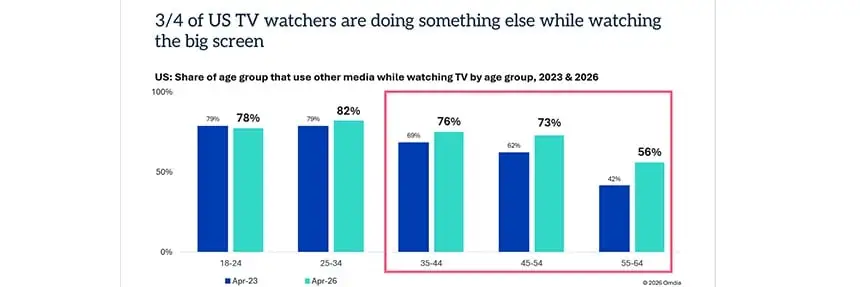





For most American viewers, watching television is no longer a single-screen experience. New research from Omdia shows that roughly three out of four TV viewers in the United States regularly use their smartphones while watching television, highlighting how increasingly fragmented audience attention has become.
The findings were presented at IBC 2026 in Amsterdam by María Rúa Aguete, Global Head of Media & Entertainment at Omdia. They point to a significant change in the relationship between television and mobile video: rather than choosing one screen over the other, audiences are increasingly consuming content across both simultaneously.
The Second Screen Is Reaching Older Audiences
While simultaneous smartphone use has long been associated with younger viewers, Omdia’s research suggests that second-screen behavior is spreading across age groups.
Among Americans aged 55–64, the share using other media on their phones while watching television increased from 42% in 2023 to 56% in 2026. The change is also pronounced among viewers aged 45–54, with usage rising from 62% to 73% over the same period.
The shift is particularly relevant as smartphones become increasingly dominated by personalized, scrollable video formats. Short-form and vertical video are no longer simply competing with television for time spent on a separate device; they are competing for attention while the television is already on.
“We don’t have a content problem. We have an attention problem,” Rúa Aguete said during the IBC presentation, pointing to the growing amount of video consumed on smartphones while viewers are also watching TV.
From TV vs. Mobile to TV and Mobile
For broadcasters and streaming platforms, the findings suggest that the traditional idea of television and mobile as competing forms of entertainment may need to be reconsidered.
With both screens active at the same time, the challenge is increasingly about understanding how viewers divide their attention between them. This also creates new considerations for advertisers, particularly as short-form video platforms become more effective at capturing highly personalized engagement.
Omdia argues that the industry should therefore move toward a dual-screen approach, developing content and advertising strategies that work across television and mobile rather than treating smartphones purely as a threat to traditional viewing.
“The future isn’t TV versus mobile. It’s TV and mobile,” Rúa Aguete added, emphasizing that companies able to understand how audiences move between screens, and capture attention on both, will be better positioned in an increasingly fragmented media environment.
The research comes at a time when the boundaries between television, streaming and mobile video are becoming increasingly fluid. As audiences develop more simultaneous viewing habits, securing their attention may prove to be a more significant challenge for the industry than simply producing more content.
Omdia Study Challenges Assumptions About Micro Drama Audiences