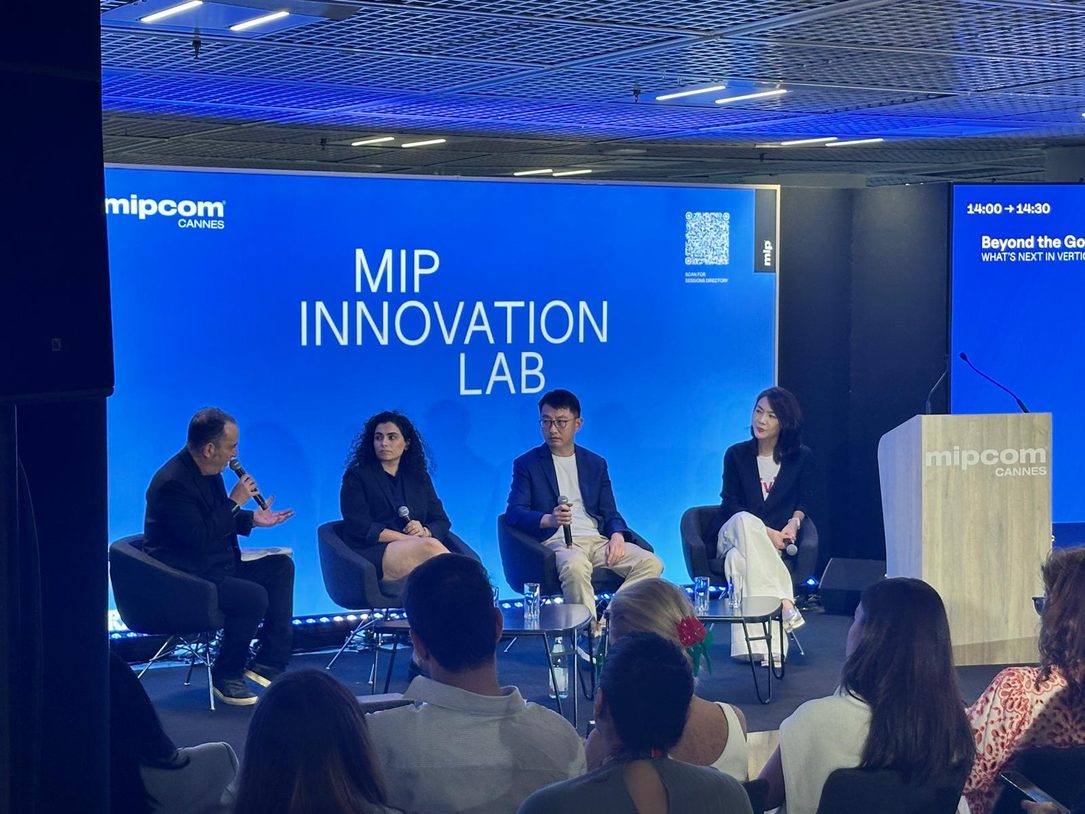




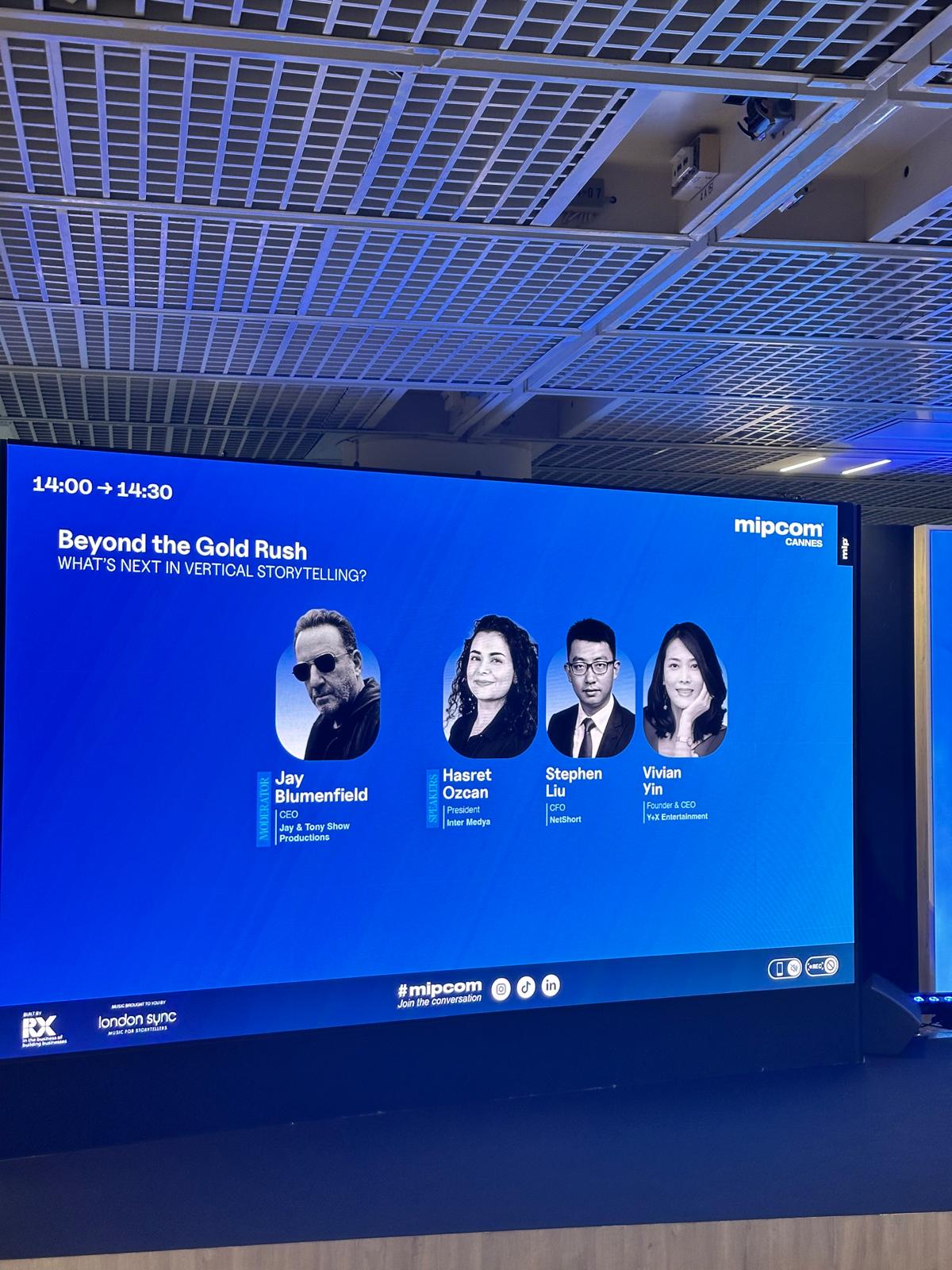
The future of vertical storytelling and its place in the global content landscape took center stage at MIPCOM 2026 during the Innovation Lab session Beyond the Gold Rush: What’s Next in Vertical Storytelling? The panel brought together industry executives to discuss evolving formats, audience behavior, and the opportunities emerging as vertical series gain traction across international markets.
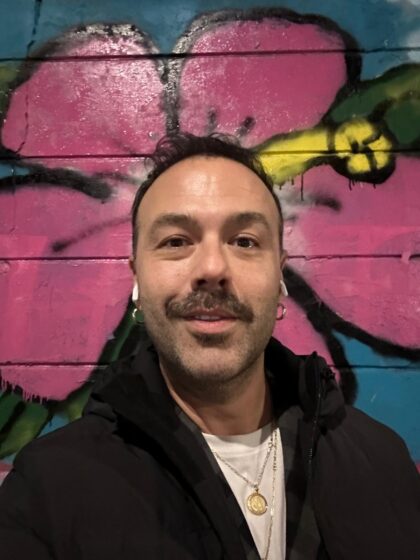
Moderated by Jay Blumenfield, CEO of Jay & Tony Show Productions, the discussion featured Hasret Özcan, President of Inter Medya; Stephen Liu, CEO of NetShort; and Vivian Yin, Founder and CEO of Y+X Entertainment.
Hasret Özcan on Different Formats and Audience Habits
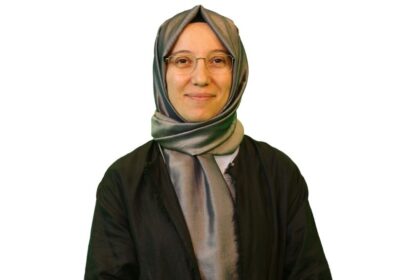
Hasret Özcan highlighted the differences between television and digital content formats in Türkiye and other markets, emphasizing that viewing habits and the definitions of emerging formats vary from country to country. While Turkish television is traditionally dominated by long-running weekly dramas, shorter series and vertical productions are finding their own audiences across digital platforms.
“In Türkiye, we have feature films, we have a long form, we have the miniseries, and we have vertical side. And I think this changes from country to country,” Hasret Özcan explained.
She also addressed the distinction between Türkiye’s so-called new-generation series and the miniseries format in other markets, noting that formats considered new in one country may already be established elsewhere.
“So with our miniseries, we call them the new generation Turkish series, but they’re only new generation for Türkiye. In fact, for the UK or the US or any other country, the miniseries, that’s what they have on TV anyway. Whereas on our TV we don’t have eight-episodic series. We only have those long-running, two-and-a-half hours that run on a weekly basis.”
Vertical Content Beyond Mobile Apps
According to Hasret Özcan, the growth of different distribution channels has created distinct audience segments across television, YouTube, subscription-based streaming services, and mobile-first platforms. Although these audiences can overlap, she argued that each format has its own viewing habits and content expectations.
“I think viewership, not just in Türkiye, but viewership worldwide changes between YouTube, TV, mobile phone, and digital platforms. And I think each of them, although there’s overlapping, each of them have their own viewerships. Each of them have their own audiences.”
Hasret Özcan also pointed to examples of vertical content being adapted for traditional television, suggesting that the format’s potential extends beyond mobile applications. She described how some TV stations have presented vertical series on television by blurring the sides of the image and scheduling short segments throughout their programming.
“And I’ve seen, although we say vertical series on mobile apps only, I have seen TV stations of vertical series on their TV as well, by just blurring the sides and having it in a five-minute slot every thirty minutes, for example. So we’ve seen that happening. And the reason why is because there’s the audience for every type of content anywhere.”
Finding the Right Place for Vertical Storytelling
Hasret Özcan stressed that the challenge for the industry is not simply to distribute vertical series through mobile apps, but to identify how the format can reach viewers across different platforms and markets.
Using Türkiye as an example, she noted that long-running dramas dominate traditional television, while miniseries, films, and vertical productions are generally distributed through other channels. This illustrates how content formats can serve different audiences within the same market.
“So you cannot totally— going back to Türkiye again, we have our long form on TV. We don’t have our verticals there. We don’t have our miniseries there. We don’t have any other kind of the long form, the movies. So the audience for YouTube, the audience for Netflix, Amazon, HBO, and the audience for verticals are completely different.
And I think there’s a differentiation in the world in each different countries. We’ve just got to address. We’ve just got to fit where the vertical could potentially fit, and not just to fit on a mobile app, but to actually have the storytelling being shown through digitalized as well as TV, as well as the vertical mobile-friendly and accessible on the internet.”
Hasret Özcan’s remarks underscored a broader industry question: as vertical storytelling expands internationally, its long-term prospects may depend on understanding local viewing habits and finding distribution strategies that allow the format to reach audiences beyond a single platform.