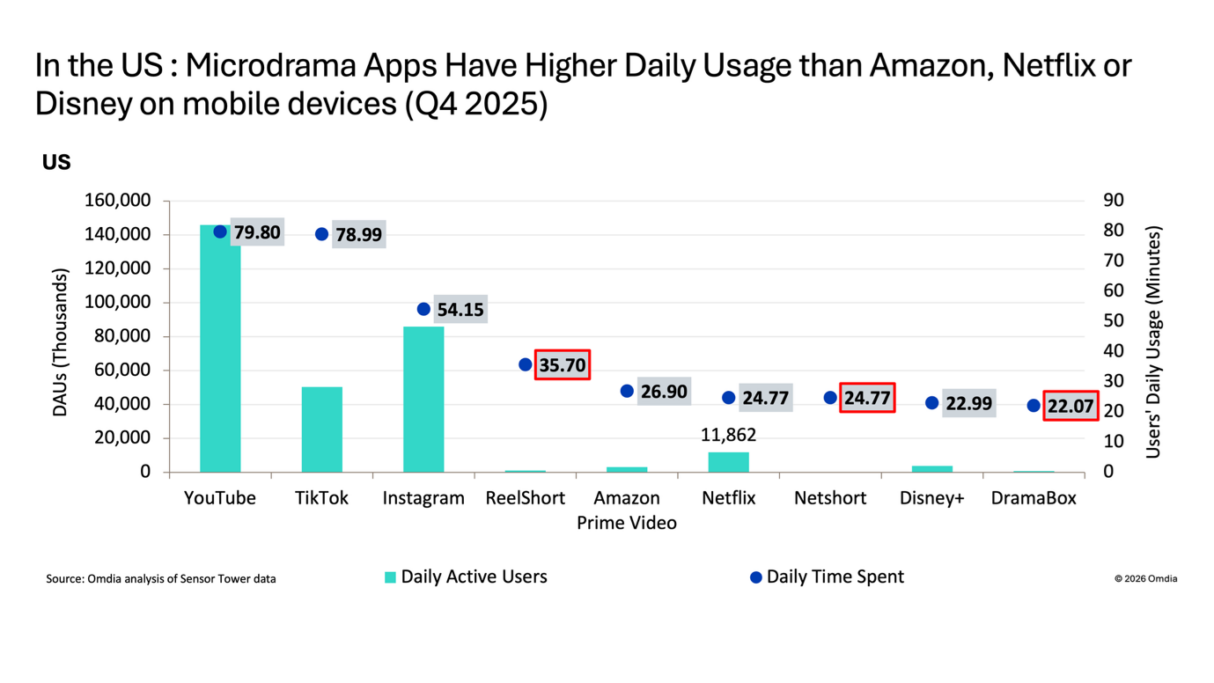







Microdrama is no longer a niche category. According to Omdia, vertical microdrama apps in the U.S. are now generating more daily mobile viewing time than major streaming platforms such as Netflix, Disney+ and Prime Video.
What began as a format largely associated with the Chinese market has rapidly evolved into a global content and revenue driver, particularly in mobile-first environments.
Engagement levels illustrate the scale of this shift. ReelShort, one of the leading microdrama platforms, averages 35.7 minutes of daily viewing time per user, surpassing Netflix’s 24.8 minutes on mobile. While traditional streamers continue to dominate overall subscription numbers and long-form consumption, microdramas are proving exceptionally competitive in the battle for daily attention on smartphones.
The financial trajectory is equally striking. Global microdrama revenues are projected to reach $11 billion in 2025 and grow to $14 billion by the end of 2026. By 2030, the market is expected to exceed $20 billion, positioning the format as one of the fastest-growing segments within the broader digital entertainment ecosystem.
Although the bulk of revenues still originate in China, the United States has emerged as the largest market outside the country. By the end of 2026, the U.S. could account for nearly half of all microdrama revenues generated beyond China, underlining the format’s growing international scalability.
The core audience currently consists of women aged 25–45, drawn primarily to emotionally driven narratives centered on romance, melodrama and heightened conflict. However, producers and platforms are increasingly developing strategies to expand male viewership and diversify genre offerings. Episodes typically run between one and three minutes and are designed specifically for vertical viewing, reinforcing their mobile-native identity.
Discovery and distribution are closely tied to social media ecosystems. Platforms such as YouTube, TikTok and Instagram function as key funnels for audience acquisition, amplifying viral moments and accelerating user growth. In this sense, microdramas operate at the intersection of streaming, social media and short-form video culture.
Importantly, microdramas are not competing with traditional television or long-form streaming on scale. Instead, they are winning on intensity; maximizing daily engagement, repeat viewing and habitual consumption. As a result, major platforms including Disney+, ViX and GloboPlay have begun experimenting with vertical short-form models, signaling that the format is influencing broader content strategies.
Microdramas may not replace established viewing models, but they are undeniably reshaping how stories are consumed on mobile and redefining what success looks like in the attention economy.